Home Treatments Dental implants
Dental implants
A replacement tooth with a root of its own
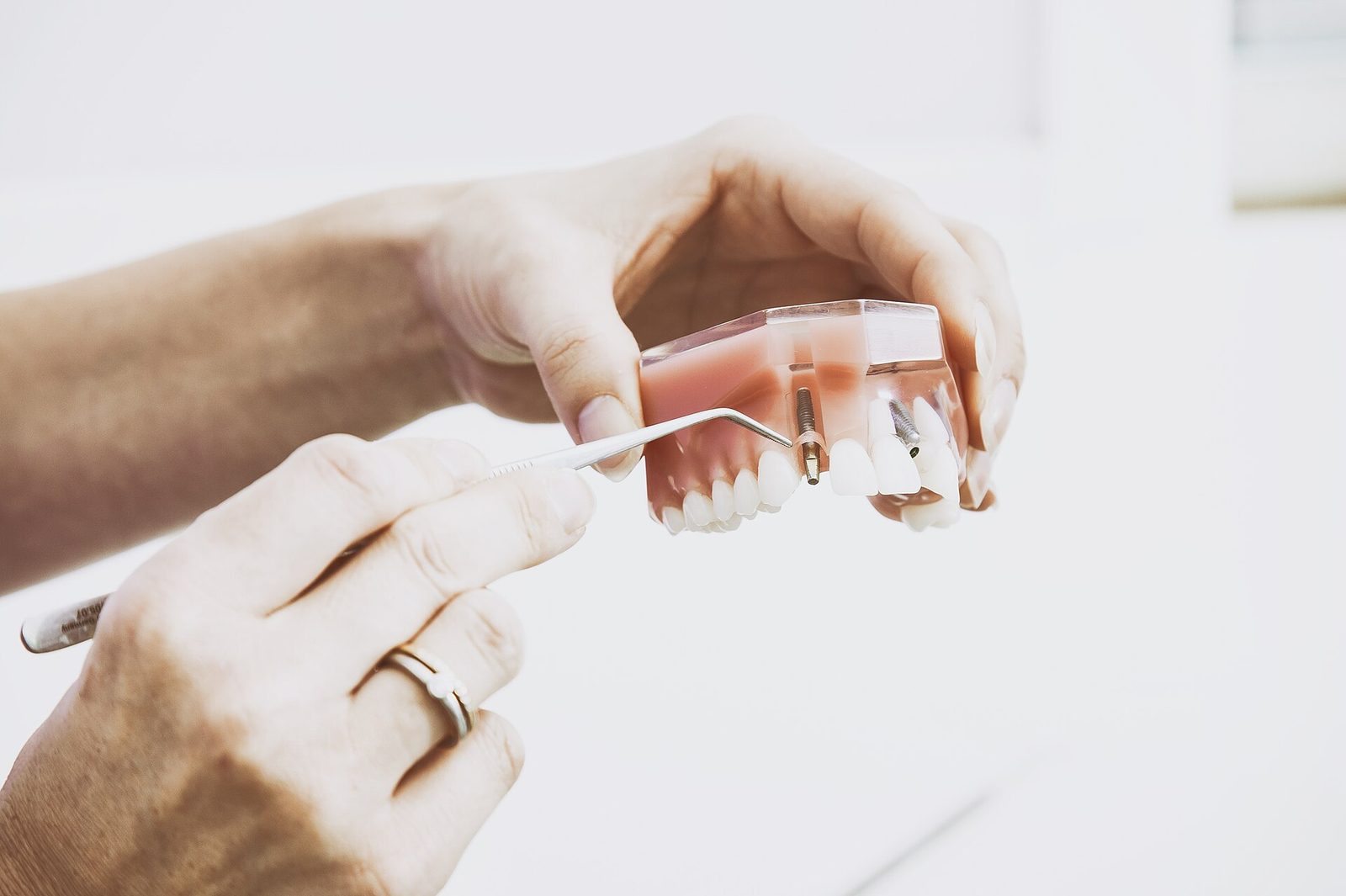
An implant is a small titanium post placed into the jawbone to take the place of a missing root. Once the bone has grown around it, a crown is fitted on top. It is the closest thing to getting the tooth back.
What it is
A missing tooth is not only a gap. The bone that held its root has nothing left to do, and over the following years it slowly shrinks. The teeth either side lean towards the space and the tooth above or below drifts down into it. Chewing moves to the other side, and that side wears faster.
An implant addresses the root as well as the crown. A titanium post, a few millimetres wide, is placed into the bone where the root used to be. Over the next three to six months bone grows tightly onto its surface — a process called osseointegration. Only then is a crown attached.
Because it is anchored in bone, an implant does not rely on the neighbouring teeth. A bridge, by contrast, needs the teeth on either side to be cut down to carry it — including teeth that may be perfectly healthy. Where several teeth are missing, a small number of implants can also secure a denture that would otherwise move.
Implants are not right for everyone or every site. Enough bone of the right quality has to be there, gums need to be healthy first, and smoking and uncontrolled diabetes both reduce the chance of the bone bonding properly. Those are conversations to have honestly before anything is planned, not after.
You may need this if…
- A single missing tooth you do not want to replace with a bridge
- Several missing teeth in the same area
- A denture that moves when you eat or speak
- A tooth that cannot be saved and is due for extraction
- A long-standing gap where the neighbouring teeth have begun to tilt
What happens, step by step
Assessment and planning
Examination, X-rays, and where the site needs it, a 3D scan to measure the height and width of bone available and locate the nerve. Health conditions and medication are reviewed at this point, because some affect healing.
Preparing the site
If the bone has shrunk too far, grafting may be needed first, and that adds months before the implant can go in. You will be told this at planning, not discovered halfway.
Placing the implant
Under local anaesthetic, the gum is opened, the socket prepared and the post placed. The gum is closed over or around it. Most people describe it as easier than an extraction.
Healing
Three to six months while bone grows onto the implant. A temporary tooth can usually be worn during this time so you are not left with a visible gap.
The crown
Once the implant is solid, an impression or scan is taken and a crown is made to match your other teeth in shape and shade, then fixed onto the implant.
Review
Checks at intervals afterwards. An implant cannot decay, but the gum and bone around it can become inflamed, and that is what reviews are looking for.
Looking after it afterwards
- Swelling and bruising for a few days after placement is normal.
- Soft food and no chewing on that side while it heals.
- Keep the area meticulously clean — brushing, and cleaning between the teeth as shown.
- Do not smoke. It is the single biggest avoidable cause of implant failure.
- Keep your review appointments even when nothing hurts.
Questions people actually ask
How long do implants last?
Many last for decades. What decides it is not the implant but the gum and bone around it — which means cleaning and regular reviews, exactly as with natural teeth.
Is the surgery painful?
The placement itself is done under local anaesthetic and is usually more comfortable than people expect. There is soreness and swelling for a few days afterwards, managed with ordinary painkillers.
Why does it take so many months?
The waiting is the bone growing onto the implant. Loading it too early is how implants fail, so the time is not padding.
Can I have one if I have been missing the tooth for years?
Often yes, but the bone may have shrunk and need grafting first. A scan tells us what is actually there before anything is promised.
This page is general information about dental implants. It is not advice about your own mouth — for that you need to be examined.
Related
People reading this also looked at
Want to talk it through first?
A consultation is a conversation and an examination. You leave with a written plan and a price, and no obligation to start.
Request an appointment